Monday, May 28, 2007
File Conversion
Zamzar supposedly will convert many different file types, including video. I haven't tried it yet, but I read about it on someone's twitter. They converted two word docs to pdfs on the site and it worked perfectly. How convenient is that?
Tuesday, May 22, 2007
If Class Were Like a Chat
This video is meant to show how inefficient online chat is. It's pretty funny.
Pay Attention
This slide show is a harangue about technology infusion. The tone is kind of self-righteous and therefore annoying, but there are some good points such as about using cell phones in instruction. My favorite line: "It's not attention deficit, I'm just not listening!"
Monday, May 21, 2007
Music Podcast
Click here to get your own player.
Steve Gwynne, a VESL teacher in San Diego, did a workshop for a few fellow teachers on using Audacity to make sound files. They each answered the question "What kind of music do you like?" and played a short music clip. He made their files into a podcast for his students, and added a quiz.
Sunday, May 20, 2007
Bubbl.us
Heard about this site today from the Webheads. It's an online brainstorming site, where you can create diagrams, link them together any way you want, and share the process with other users. I don't have any other users to try it out with on this Sunday afternoon, and anyway I'm supposed to be going to the grocery store right now or there will be no dinner. But email me if you want to try it.
If Class Were Like a Chat
I found this video on the Webheads Convergence. It shows how teaching would be if the classroom were run like a chat room. It's pretty funny.
Saturday, May 19, 2007
Webheads Convergence
The Webheads in Action Online Convergence is almost over, happening May 18-20! There were keynotes, blogs, chats, etc. They are using a lot of different tools for communication, including Twitter, Learning Times, Tapped In and Knowplace. So even just going to their site and signing up for the various tools they are using is an education in itself. I hate to say it, but there were some that I already had accounts for but had totally forgotten. Just too many things to cram into the old brain.
This morning I attended part of a presentation on Personal Learning with Web 2.0 that used and audio stream, and Yugma to show the slides. I also tried to attend a session in Second Life, but I think I was too late. I'm not doing too well at converting GMT to PDT! It seems there is so much happening in Second Life and education these days, I would like to get on top of it, but there's a steeper learning curve than for a lot of other things, and I haven't managed to make the time yet. I was happy that I found the Webheads hut where they hang out, even though most people were gone already.
Did anyone else catch part of the convergence? Leave a comment and let me know what you participated in and how it was.
This morning I attended part of a presentation on Personal Learning with Web 2.0 that used and audio stream, and Yugma to show the slides. I also tried to attend a session in Second Life, but I think I was too late. I'm not doing too well at converting GMT to PDT! It seems there is so much happening in Second Life and education these days, I would like to get on top of it, but there's a steeper learning curve than for a lot of other things, and I haven't managed to make the time yet. I was happy that I found the Webheads hut where they hang out, even though most people were gone already.
Did anyone else catch part of the convergence? Leave a comment and let me know what you participated in and how it was.


Saturday, May 12, 2007
Some Reflections on TIMAC
We just finished up the third year of the OTAN Technology Integration Mentor Academy. It was a great two days, with presentation by cohort 3 on Thursday, and cohort 2, the second year people who are finished now, on Friday. It worked out really well having 7 minute presentations, much easier to sit through 15 in a row, and the information was more succinct too.
So much has come out of this experience. It really feels like we are beginning to have some effect on the field. There are more and more tech presentations at conferences like CCAE, and many of them are by TIMAC participants or mentors. They are also networking with each other more, and even beginning to do workshops at each others' sites.
Leila Rosemberg said one of the outcomes of TIMAC for her was being showered with admiration and appreciation. It made me laugh, but it's so important, too. The teachers who have come to TIMAC have experienced a lot of benefits that come from being seen as a leader. They didn't start out thinking of themselves that way, but through technology mentoring they have affected their programs and their administrators notice.
Another observation someone made is that "there is an alarming acceleration in the number of things I know nothing about." I loved that line too, and I can relate!
Overall, there were some wonderful applications of technology, such as podcasting and creating of student orientation videos and powerpoints. It seemed that there were quite a lot of powerpoint projects, which was a little frustrating. But I always need to be reminded of where our teachers are, overall. They are not tech-friendly, for the most part, and sometimes very resistant. So powerpoint is a good place to start for them.
The other thing is the number of creating teaching strategies you can implement with powerpoint. Using sound and video, one teacher got the script of her video to scroll in ppt in time with the video - pretty good!
And I felt that the participants are being good advocates for both their students and their mentees. Branka should be very proud of her work in putting this together, and I am too!
So much has come out of this experience. It really feels like we are beginning to have some effect on the field. There are more and more tech presentations at conferences like CCAE, and many of them are by TIMAC participants or mentors. They are also networking with each other more, and even beginning to do workshops at each others' sites.
Leila Rosemberg said one of the outcomes of TIMAC for her was being showered with admiration and appreciation. It made me laugh, but it's so important, too. The teachers who have come to TIMAC have experienced a lot of benefits that come from being seen as a leader. They didn't start out thinking of themselves that way, but through technology mentoring they have affected their programs and their administrators notice.
Another observation someone made is that "there is an alarming acceleration in the number of things I know nothing about." I loved that line too, and I can relate!
Overall, there were some wonderful applications of technology, such as podcasting and creating of student orientation videos and powerpoints. It seemed that there were quite a lot of powerpoint projects, which was a little frustrating. But I always need to be reminded of where our teachers are, overall. They are not tech-friendly, for the most part, and sometimes very resistant. So powerpoint is a good place to start for them.
The other thing is the number of creating teaching strategies you can implement with powerpoint. Using sound and video, one teacher got the script of her video to scroll in ppt in time with the video - pretty good!
And I felt that the participants are being good advocates for both their students and their mentees. Branka should be very proud of her work in putting this together, and I am too!
Thursday, May 10, 2007
More on Maps
Larry Ferlazzo pointed out that there are a number of mapping sites, including Google Maps, (Click on My Maps)which has some nice examples of projects, like a historical guide to Route 66. Here is a student project by one of his ESOL high school students.
Other map sites he recommends to his students are Microsoft Virtual Earth, Continento, Wayfaring, QuickMaps, Click2Map,
Other map sites he recommends to his students are Microsoft Virtual Earth, Continento, Wayfaring, QuickMaps, Click2Map,
Wednesday, May 09, 2007
UseaMap.com
I got an email from a person in Dublin who has created a mapping site, like TinyMap, where you can create your own map, save it online, link to it, and also easily embed it in your blog or anywhere else online. The site is called Useamap. I made a map of where OTAN is. Unfortunately, the satellite photo is old, so there is only a vacant lot where our offices now stand, but hopefully that won't be the case for your school or community! Our building is quite new.
This could be a nice activity for anything that involves mapping, distances, math, community information, etc. You can also add notes, directions, comments and photos (although I couldn't get the photos to work.)
Monday, May 07, 2007
Blogs and Podcasts at CCAE
Branka Marceta gave a wonderful workshop at the California Council on Adult Education conference on blogs and podcasts in adult ed. She asked people to call GabCast on their cell phones before the workshop started, and then played the resulting podcasts at the end. You can click on an example on the blog she set up for the workshop.
 She also added a video of the evening activity, which included feeding giraffes at the Fresno zoo!
 She also added a video of the evening activity, which included feeding giraffes at the Fresno zoo!
Friday, May 04, 2007
TIMAC Videoconference

Last week the third annual TIMAC videoconference was held, including about 15 people at 6 sites. None of the schools have access to videoconferencing equipment yet, but several are considering purchases. I'm really hoping that by next year there will be at least two schools that can do a collaborative project with students using videoconferencing.
Again this year we visited Ano Nuevo State Park where they have a webcam on the beach to observe the elephant seals. It's fun for the participants, and one thought about how it might fit into adult education is community awareness. For example, the teacher from Fresno, Susan Guzzetta, said that a lot of their students have never been outside of the central valley, so here would be their chance to see the beach, and some of the state parks - the next best thing to being there.
CCAE Conference in Fresno
The first day of the California Council on Adult Education was today. I was at the TIMAC (Technology Integration Mentor Academy) panel, and all panelists did a great job. We really are creating a community of practice, as Branka said, or at least a corps of ed tech professionals in adult education. Stories from Tulare, San Gabriel and Fresno confirmed that technology integration is a collaborative effort. Having a supportive administrator is crucial, and so is having a good relationship with the tech support guys. I want to make a video about the Pixley project. Tom Elwood told a great story about this tiny farming town south of Tulare, very poor, very low education levels in general, where a grant from AT&T, secured by a community organization, is providing wireless for the whole town, and laptops to the parents of any sixth grader in Pixley, if the complete a computer class. What a great story! The parents are gratuating and receiving their laptops in a couple of weeks.
Tuesday, April 24, 2007
Life of a Digital Native

I saw this cartoon on Vicki Davis's CoolCatTeacher blog. It reminded me how different life is for our children (and in some cases, grandchildren) than it was for us. It used to be if you did something embarrassing you thought you would die if some of your friends saw it. Now the whole world can see!
Sunday, April 22, 2007
How My Reading Habits Have Changed
Larry Ferlazzo passed on the meme asking about what magazines I read, and how my reading habits have changed over the last year.
First of all, my reading habits have changed a lot! I was actually thinking about that today and wondering if I should be sad about it. I used to read books, especially literary novels. I think the last one I read was The Amazing Adventures of Kavalier and Clay by Michael Chabon, which I loved. Now I have a couple of books started, including Snow by Orhan Pamuk, but I don't read extended texts the way I used to. I go through periods when I only read magazines, which I never used to do before. And the magazines I read have changed.
Larry mentioned the New Yorker. I used to read it, and my idea of a great vacation day is still sitting at the kitchen table or outside in the sun and reading the New Yorker from cover to cover, but I just don't have time to do it any more. I finally even quit subscribing. There are a lot of magazines I used to get that I don't get any more. The ones I still get are Newsweek, Cooking Light, and Wired. I love to see each one of them in my mailbox.
The magazines I read at work are Learning and Leading with Technology, and lately I've been finding good articles in Computers in Libraries (Librarians are getting into Second Life!)
There are tons of other publications that come across my desk and that I try to keep up with, including eSchool News. Also journals of professional organizations I belong to.
But the biggest change is that I listen to podcasts more than I read. I listen to TWiT and Buzz Out Loud to keep up with technology, and I just started listeing to EdTechTalk, a great podcast on ed tech topics. And then I listen to Fresh Air and This American Life, both of which I love, and a bunch of other ones about books and authors.
When I think about all there is to read, listen to, watch and learn, I want to quit work right now so I can absorb it all!
First of all, my reading habits have changed a lot! I was actually thinking about that today and wondering if I should be sad about it. I used to read books, especially literary novels. I think the last one I read was The Amazing Adventures of Kavalier and Clay by Michael Chabon, which I loved. Now I have a couple of books started, including Snow by Orhan Pamuk, but I don't read extended texts the way I used to. I go through periods when I only read magazines, which I never used to do before. And the magazines I read have changed.
Larry mentioned the New Yorker. I used to read it, and my idea of a great vacation day is still sitting at the kitchen table or outside in the sun and reading the New Yorker from cover to cover, but I just don't have time to do it any more. I finally even quit subscribing. There are a lot of magazines I used to get that I don't get any more. The ones I still get are Newsweek, Cooking Light, and Wired. I love to see each one of them in my mailbox.
The magazines I read at work are Learning and Leading with Technology, and lately I've been finding good articles in Computers in Libraries (Librarians are getting into Second Life!)
There are tons of other publications that come across my desk and that I try to keep up with, including eSchool News. Also journals of professional organizations I belong to.
But the biggest change is that I listen to podcasts more than I read. I listen to TWiT and Buzz Out Loud to keep up with technology, and I just started listeing to EdTechTalk, a great podcast on ed tech topics. And then I listen to Fresh Air and This American Life, both of which I love, and a bunch of other ones about books and authors.
When I think about all there is to read, listen to, watch and learn, I want to quit work right now so I can absorb it all!
Tuesday, April 17, 2007
CATESOL 2007
What a great conference! I didn't get to go to many presentations because of my own workshops and helping with the Electronic Village, but I thought the EV was really great this year - 3 labs, and busy all the time! Next year in Sacramento will be even better!
It really feels like we've turned a corner with technology. It's no longer a new, exotic topic that a few are enthusiastic about and the rest pay no attention to. There were 53 technology presentations, 26 related to adult education or presented by adult educators. Many workshops on using PowerPoint in the classroom, and on Audacity and other sound recording options for creating podcasts and various online listening activities. I would say sound was the big tech topic this year.
The evening presentation on the lost boys from Sudan was wonderful. What an incredible story those young men have - horrifying, but for those who survived, a true triumph of the spirit. It was inspiring.
It really feels like we've turned a corner with technology. It's no longer a new, exotic topic that a few are enthusiastic about and the rest pay no attention to. There were 53 technology presentations, 26 related to adult education or presented by adult educators. Many workshops on using PowerPoint in the classroom, and on Audacity and other sound recording options for creating podcasts and various online listening activities. I would say sound was the big tech topic this year.
The evening presentation on the lost boys from Sudan was wonderful. What an incredible story those young men have - horrifying, but for those who survived, a true triumph of the spirit. It was inspiring.
EdTechTalk
I've been looking for ed tech podcasts to listen to while I'm traveling, at the gym, etc. Branka turned me on to this one, EdTechTalk. It's K12 teachers, not adult educators, but they are very enthusiastic explorers of technology, and host 5 or 6 shoes a week. You can log on and participate in their chat rooms during the shows, or subscribe and listen to the shows later. Lots of good information, references to other Web sites. It's interesting to hear what techie teachers are thinking about and experimenting with.
Wednesday, April 11, 2007
CATESOL Starts Tomorrow!
Getting ready for my Web 2.0 session with Donna Price on 4/13. I only have 25 minutes, so have to really condense. It feels like so much has changed even since February, the last time I did this workshop. I'm showing Web2.0Slides, a slide show of over 1400 Web 2.0 slides. Gives some perspective on how fast this sector is growing.
Here are my workshops:
Using Technology to Transcend Borders
Friday at 11
Towne Room
TELL Interest Group Colloquium
(TELL = Technology-Enhanced Language Learning)
Friday 2:30 to 4
Brittany Room
OTAN Online Resources for ESL Teachers
Saturday at 11:15
Terrace Salon 2
Create Your Lesson Plans Online!
Saturday 1:30 to 3
Pacific
Salon 4
Here are my workshops:
Using Technology to Transcend Borders
Friday at 11
Towne Room
TELL Interest Group Colloquium
(TELL = Technology-Enhanced Language Learning)
Friday 2:30 to 4
Brittany Room
OTAN Online Resources for ESL Teachers
Saturday at 11:15
Terrace Salon 2
Create Your Lesson Plans Online!
Saturday 1:30 to 3
Pacific
Salon 4
Monday, April 09, 2007
Using Google Calculator to Teach Math
Here is a message from Margaret Rogers. Margaret is an adult educator and GED specialist in California who is also on the board of COABE. She learned about Google Calculator at a workshop at the CA Technology and Distance Learning Symposium. Google calculator isn't a separate tool, but a collection of calculations you can make using the search box. Here's how Margaret used what she learned:
I just wanted you to know that I did win the contest at my athletic club for National Nutrition Month by guessing the number of popcorn kernels in a plastic container. There were 7735, and I guessed 7188 using the skills you taught me with the Google calculator going from cubic inches to cups in a second! I won the container of kernels and a cool sweatshirt.
I also used the Google calculator to calculate some of the items for my Mathematics of Oil presentation for COABE. I was sharing it with my participants, and not one of them (26) knew about the Google calculator. I will be incorporating it into all of the math workshops I do from now on.
Thanks for your help.
Margaret
I just wanted you to know that I did win the contest at my athletic club for National Nutrition Month by guessing the number of popcorn kernels in a plastic container. There were 7735, and I guessed 7188 using the skills you taught me with the Google calculator going from cubic inches to cups in a second! I won the container of kernels and a cool sweatshirt.
I also used the Google calculator to calculate some of the items for my Mathematics of Oil presentation for COABE. I was sharing it with my participants, and not one of them (26) knew about the Google calculator. I will be incorporating it into all of the math workshops I do from now on.
Thanks for your help.
Margaret
Another Cartoon Site - ToonDoo
There seem to be a lot of these cartoon sites now. This one was quick and easy to use, and you can upload your own photos too.
Friday, April 06, 2007
Twitter: Take Two
Ok, I wrote a few days ago about Twitter that I don't get it - why would I want to get updates constantly about what my friends are doing? But...I got kind of addicted to twittering anyway. It's interesting to see what people are doing, people like Leo Laporte or Veronica Belmont, whose podcasts I've been listening to, and people like Jason Calacanis and Anil Dash who I know hardly anything about but I discovered them through looking at other people's friend lists, or at twitterholic which shows who has the most followers on Twitter.
These people post what they're doing, which is often flying somewhere or having sushi with someone, which is not important unless you're friends with them, but they also post links to their blogs, or blogs of others that they are thinking about, or links to conferences they are attending, and, following those links, I learn things.
Tonight, after a day of work on budgets and getting ready for CATESOL next week, and then a couple of hours of dancing, I came home and sat down to print my boarding pass, etc., and ended up checking my Twitter account, following a few links, reading about tags, about Ajax, about supporting the people of Uganda, and about the relationship between science and culture. I'm liking this! It feels like a time of intellectual ferment and development. These times seem to come and go in life. Maybe I've been missing that.
These people post what they're doing, which is often flying somewhere or having sushi with someone, which is not important unless you're friends with them, but they also post links to their blogs, or blogs of others that they are thinking about, or links to conferences they are attending, and, following those links, I learn things.
Tonight, after a day of work on budgets and getting ready for CATESOL next week, and then a couple of hours of dancing, I came home and sat down to print my boarding pass, etc., and ended up checking my Twitter account, following a few links, reading about tags, about Ajax, about supporting the people of Uganda, and about the relationship between science and culture. I'm liking this! It feels like a time of intellectual ferment and development. These times seem to come and go in life. Maybe I've been missing that.
New Blog for ESOL Learners
Clarissa Ryan had a couple of students who were going back to Korea and asked her how they could keep improving their English. She started readableblog.com to share links with them for free online learning resources. She is just getting started, but I think this will take off. She has some good links to sites for creating cartoons, one that let's you use your own digital photos. Here is a comic strip she made with Comeeko.


Tuesday, April 03, 2007
TeacherTube and MLoTS
Viral video is taking over the world, even the world of teaching! It seems like a few months ago we were talking about Barry Burkett's video of his ESL class posted on YouTube, and now suddenly there is such a proliferation of teacher-made videos! The adult education version, being developed by David Rosen and Friends, Media Library of Teaching Skills, is in its beginning stages, with two videos posted currently of an ABE vocabulary lesson. But there are plans to train teachers all over the country to videotape each other, and to enlist states to link their state adult ed standards to video examples.
Another example I found today is TeacherTube, a YouTube for teachers. It contains only teacher- and student-made videos illustrating the teaching and learning of many concepts in many different content areas. There is no reason that adult education videos couldn't be uploaded here. I had a technical problem that I have to figure out, my uploading video got timed out, but I'll try it again from home. It's amazing to see the energy and creativity that is going into this work!
Another example I found today is TeacherTube, a YouTube for teachers. It contains only teacher- and student-made videos illustrating the teaching and learning of many concepts in many different content areas. There is no reason that adult education videos couldn't be uploaded here. I had a technical problem that I have to figure out, my uploading video got timed out, but I'll try it again from home. It's amazing to see the energy and creativity that is going into this work!
Mainstream Media Picks Up on Ed Tech
A few weeks ago I posted about a story in the San Diego paper on ed tech in universities. This morning in the Sacramento paper there is a front page story on using technology in K12, featuring a high school teacher who uses Google Earth to have his students look at locations of Shakespeare plays such as Cyprus and Venice (Othello), and YouTube videos of Shakesperean actors.
It's encouraging that the mainstream media is picking up on ed tech stories. We need to work on getting adult education into the mix.
It's encouraging that the mainstream media is picking up on ed tech stories. We need to work on getting adult education into the mix.
Tuesday, March 27, 2007
Reflections on MySpace and Twitter
Boy, am I getting old! I spent an hour on the phone with my son Larry tonight, getting him to give me the MySpace addresses of his friends so I could see what young people are doing. It's all about sex, drugs and rock and roll, as we used to say, and I guess we used to say that for a reason, but it seems so long ago now...
I created a MySpace page just to see what it was like, but I don't have time to add my favorite music, music video, and get 1200 "friends" to link to me. It seems that collecting friends is like collecting pogs was when my son was 9.
And here's another one I don't get - Twitter. You can post a short sentence about what you're doing once a minute if you want to. I'm posting on my blog. I'm sitting in the recliner with my cat. I'm talking on the phone. Does anyone care?? I'm definitely missing something here, as this is quite a popular site at the moment. It's all about being connected. As the Dalai Lama says, we all want to be loved and we all want to be happy, and they go together. We are herd animals, and we like to feel connected to, even enveloped by, our group. Ah well, I guess I'm turning into an old curmudgeon.
I created a MySpace page just to see what it was like, but I don't have time to add my favorite music, music video, and get 1200 "friends" to link to me. It seems that collecting friends is like collecting pogs was when my son was 9.
And here's another one I don't get - Twitter. You can post a short sentence about what you're doing once a minute if you want to. I'm posting on my blog. I'm sitting in the recliner with my cat. I'm talking on the phone. Does anyone care?? I'm definitely missing something here, as this is quite a popular site at the moment. It's all about being connected. As the Dalai Lama says, we all want to be loved and we all want to be happy, and they go together. We are herd animals, and we like to feel connected to, even enveloped by, our group. Ah well, I guess I'm turning into an old curmudgeon.
Instant Video
My colleague Branka was at TESOL in Seattle, where she recorded a short video of the a presentation in the Electronic Village, and posted it on Google video. It makes me realize how we are more and more able to see what others are doing almost instantly from anywhere in the world.
What can adult learners do with Google video or YouTube? Already teachers are videoing each other and posting videos, for the MLoTS project (Media Library of Teaching Skills). The idea of this project is to train teachers to video each other, create short clips (10 min. max) of specific teaching techniques tied to standards or best practices, and make these available in a searchable database.
What can adult learners do with Google video or YouTube? Already teachers are videoing each other and posting videos, for the MLoTS project (Media Library of Teaching Skills). The idea of this project is to train teachers to video each other, create short clips (10 min. max) of specific teaching techniques tied to standards or best practices, and make these available in a searchable database.
Friday, February 23, 2007
Monday, February 19, 2007
Everything You Ever Wanted to Know About Google
This 2-page Google cheat sheet lists every Google service, large services owned by Google such as Picasa and Blogger, and how to search for a UPS tracking number, a vehicle VIN number or a patent number.
TalkShoe and TinyMap
I've been having fun preparing for my Web 2.0 presentation at the adult education Technology and Distance Learning Symposium on Feb. 20-22 in Sacramento, and finding all kinds of new social networking sites. One is TalkShoe, that lets you call in and create a podcast with as many other people as you like, save the audio file and make it available as a podcast.
Another fun one was TinyMap, a site that let's you create your own map, put routes and markers on it, and save it with its own URL. For example, here is a map of my daily walk in Florida Canyon from my old house.
Another fun one was TinyMap, a site that let's you create your own map, put routes and markers on it, and save it with its own URL. For example, here is a map of my daily walk in Florida Canyon from my old house.
Wednesday, February 14, 2007
Wikipedia Has Links to Public Domain Graphics
Jeff Carter posted this on his blog. Wikipedia has a good collection of sites containing public domain art, clip art and photos that can be used on Web sites or elsewhere.
Monday, January 29, 2007
Ways that College Teachers and Students Use Technology
Here are the numbers that were included in the article mentioned in the previous post.
Educator-related activities:
- 78 percent of professors use email to supplement or supplant office hours
- 55 percent provide hyperlinks within their online syllabuses to provide more resources
- 54 percent post their handouts and/or slide presentations
- 42 percent have Web sites or similar tools available for individual courses
Student-course related activities:
- 77 percent research their school assignments online
- 74 percent check their grades online
- 51 percent complete their class assignments online
- 49 percent look up assignments from instructors
Other student activities:
- 90 percent send or receive email
- 68 percent check the weather forecast online
- 66 percent send or receive online instant messages
- 60 percent check out someone's online profile
Reporter: Eleanor Yang Su, San Diego Union-Tribune
Sources: Campus computing Project Survey, Dec. 2006, Student Monitor spring 2006 lifestyle and media study
Technology used by college students
I was in San Diego last weekend, and the Sunday paper had a front page article about educational technology and college students. It talks about the ways that today's college students are comfortable multi-tasking during class and elsewhere, and how professors are using technology to provide information and to keep students engaged. Students are online on their laptops - taking notes, IMing their friends, checking their MySpace profile, and sending text messages on their cell phones - all during class. Teachers are providing clickers for students to wirelessly submit answers to questions during class, with the results displayed instantaneously.
All this reinforces the importance of including technology skills as part of basic literacy. Adult education students who transition to higher ed will be lost without some of these skills. Teachers and students alike assume that students are online, and can do research, get and submit their assignments, communicate with the teacher, and check their grades online.
The article included some numbers that also raise questions for adult educators. These somehow didn't make it onto the web version, but the reporter was kind enough to email them to me.
78 % of professors use email to communicate with students. What percent of adult education teachers do this? And what percent of adult ed students? We will have more of an answer to questions like this after the student computer surveys that are part of the technology plans are submitted, but the last results I saw were that 40 percent of teachers communicate with students at least once in a while using email (78 precent for college teachers), and 10 percent maintain a class web page (42 percent for college classes). Actually, these adult ed numbers are pretty high compared to what one might expect, but we also have a long way to go.
All this reinforces the importance of including technology skills as part of basic literacy. Adult education students who transition to higher ed will be lost without some of these skills. Teachers and students alike assume that students are online, and can do research, get and submit their assignments, communicate with the teacher, and check their grades online.
The article included some numbers that also raise questions for adult educators. These somehow didn't make it onto the web version, but the reporter was kind enough to email them to me.
78 % of professors use email to communicate with students. What percent of adult education teachers do this? And what percent of adult ed students? We will have more of an answer to questions like this after the student computer surveys that are part of the technology plans are submitted, but the last results I saw were that 40 percent of teachers communicate with students at least once in a while using email (78 precent for college teachers), and 10 percent maintain a class web page (42 percent for college classes). Actually, these adult ed numbers are pretty high compared to what one might expect, but we also have a long way to go.
Saturday, November 25, 2006
Transitioning to Postsecondary
This is not exactly related to technology, but my friend Jan Jarrell recently left adult ed after 15 years of teaching ESOL and being an administrator, and took a position on the English/ESOL faculty at San Diego City College. She has a blog at http://collegetransitions.blogspot.com/ where she is posting her thoughts about what adult ESOL students need in the way of preparation and support to be successful in college.
This is a hot topic right now in adult education. There is a whole web site devoted to transitioning adult ed students to college, the National College Transition Network. They have a list of promising practices at http://www.collegetransition.org/promising/practice.html
CAELA, an ESL Resources project, has a brief that reviews the research on transitioning adult ed students to post secondary at http://www.cal.org/caela/esl_resources/briefs/transition.html.
Focus on Basics has a whole issue on Transitions, at http://www.ncsall.net/index.php?id=154
There is also a paper from NCSALL on transition posted here
This is a hot topic right now in adult education. There is a whole web site devoted to transitioning adult ed students to college, the National College Transition Network. They have a list of promising practices at http://www.collegetransition.org/promising/practice.html
CAELA, an ESL Resources project, has a brief that reviews the research on transitioning adult ed students to post secondary at http://www.cal.org/caela/esl_resources/briefs/transition.html.
Focus on Basics has a whole issue on Transitions, at http://www.ncsall.net/index.php?id=154
There is also a paper from NCSALL on transition posted here
Wednesday, August 30, 2006
Blog by Kids in the Justice System
I got an email from an art teacher in Pennsylvania who is working with young men in a correctional facility near Harrisburg. She gave them a writing assignment, and then posted their work on her blog. The assignment was "If you were to die tomorrow, what would you want your friends and family to remember the most about you?" The answers are sometimes quite touching, and remind me that there but for fortune go I. Any of us could find ourselves in circumstances beyond our control or imagining that lead us down paths we never meant to take. The teacher is soliciting comments to take back to her students, so please take a look.
Friday, June 30, 2006
Podcasts have changed my life!
I was randomly selected to be in the Nielson ratings for radio a few weeks ago. It made me realize that I hardly ever listen to the radio any more. Why should I? I have tons of interesting content on my iPod, and I can listen to it whenever I want, with no worries about reception. Sorry, Nielson! The radio shows I really want to hear I can download and listen to at my convenience.
I haven't been doing that, though. I've been listening to tech podcasts (TWIT, Digg, BuzzOutLoud), podcasts on books and film (Authors on Tour, Books and Writing, The Book Show), and also downloading books on Buddhism and meditation (Pema Chodren, Jack Kornfield). I do have music on my iPod too, but I hardly ever listen to it. I guess I'm turning into more and more of a spoken word person in my old age!
And TV is another thing. I'm not a TV watcher. I used to have maybe one show a week that I watched, but now I don't have cable and I never turn on my TV except to watch a DVD maybe once every six months. But...I started downloading videos onto my iPod, and then I bought a package of 16 episodes of The Daily Show. OK, I haven't had time to watch all of them, but still this is more TV than I've watched in the last year!
So how will such changes as these affect adult education? Maybe not at all for a while, but pretty soon more and more of our students will have mp3 players, and more and more teachers will start experimenting with podcasting.
So far I have two good examples, both Vocational ESL teachers in San Diego, as it happens.
Steve Gwynne, at Mid City Center in San Diego, posts a podcast for his students every week.
And one more site that isn't adult education, but is interesting, is from Louis Cornelio, a Spanish teacher at a middle school in San Diego. He has done several interesting student projects on his podcast site.
I haven't been doing that, though. I've been listening to tech podcasts (TWIT, Digg, BuzzOutLoud), podcasts on books and film (Authors on Tour, Books and Writing, The Book Show), and also downloading books on Buddhism and meditation (Pema Chodren, Jack Kornfield). I do have music on my iPod too, but I hardly ever listen to it. I guess I'm turning into more and more of a spoken word person in my old age!
And TV is another thing. I'm not a TV watcher. I used to have maybe one show a week that I watched, but now I don't have cable and I never turn on my TV except to watch a DVD maybe once every six months. But...I started downloading videos onto my iPod, and then I bought a package of 16 episodes of The Daily Show. OK, I haven't had time to watch all of them, but still this is more TV than I've watched in the last year!
So how will such changes as these affect adult education? Maybe not at all for a while, but pretty soon more and more of our students will have mp3 players, and more and more teachers will start experimenting with podcasting.
So far I have two good examples, both Vocational ESL teachers in San Diego, as it happens.
Steve Gwynne, at Mid City Center in San Diego, posts a podcast for his students every week.
http://veslclass.podomatic.com/
And one more site that isn't adult education, but is interesting, is from Louis Cornelio, a Spanish teacher at a middle school in San Diego. He has done several interesting student projects on his podcast site.
Monday, May 22, 2006
Another great videoconferencing experience
 The first year Technology Integration Mentors had a great videoconference on Friday. There were a few technical glitches getting all the sites logged in, and a couple of people had to watch the streaming version online instead of participating live, but we had 6 sites logged in, and 13 participants. We managed to do all this without any budget!
First we heard from Marie Doerner, and teacher of students with disabilities in San Diego, who demonstrated for us how she teaches math to three small pull-out groups at 3 different sites in San Diego via videoconferencing. San Diego is a large district with 6 large adult ed sites. Since it's hard to get enough ABE or High School students together at one site to make a pull-out group for a particular math topic, they have solved it by having Marie teach three sites at once. She also goes to different sites on different days, so the students do have a face-to-face relationship with her as well, which they and she feel is important. They are also teaching some high school subjects via videoconferencing, including government and economics.
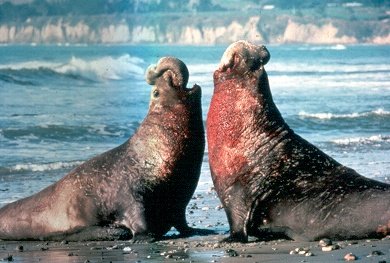
After our math lesson, we hooked up with the state park at Ano Nuevo Beach for a visit to the elephant seals on Ano Nuevo island, and a discussion with Interpreter Shawn Brown about how to use videoconferencing to teach a variety of subjects to kids. Shawn was a great host, and answered a lot of our technical questions, plus it was fun to see the elephant seals live via their webcam, and to think about how we could integrate virtual trips to state parks with basic skills instruction for adults. One possibility is to visit various state parks and get to know the park system as part of EL Civics, getting involved in the community.
We did this videoconference last year with the park site at the capitol building, and talked with some legislative staffers. This year the parks department has really developed their videoconferencing program. For schools with no access to equipment, they will even bring equipment to the school in order for the kids to have the interactive experience. Although we are probably several years away from adult schools having much access to videonconferencing equipment, I'm glad our mentors got a chance to see what the possibilities are. I expect to hear about how some of them experiment with this technology at their sites next year.
To learn more about opportunities for free videoconferencing with the California State Parks, go here.
Sunday, April 30, 2006
My Grandson and Me
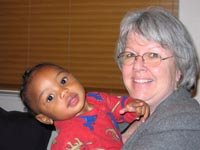
Not to be a typical grandma, but I had to post a photo in order to get a photo into my profile, so here it is. This little guy is 16 months old now, saying a few words, running around, hiding things in the garbage can, and generally being a ray of light to everyone around him. OK, I know, that's enough on that topic.
COABE 2006
I just got back from the COABE conference last night. Under the auspices of ALTN (Adult Learning and Technology Network), we did two pre-conference sessions, one on using PowerPoint in the classroom and one on digital video projects using MovieMaker. Both were very successful and participants were happy, but the turnout was disappointing. Maybe hands-on sessions like that aren't the right thing for COABE, or maybe we need to do more pre-conference publicity.
I attended Denise Guckert's very wide-rangeing session on Internet resources and got several great ideas. One that I will share here is the Web site www.quicktopic.com. On this site you can create a quick and dirty discussion board. Only one topic per board, but you can create as many as you want and it's extremely simple. I created one while I was in the workshop and emailed it to the California Technology Mentor list, and by the end of the workshop I had more than a dozen posts. You can see it here.
I attended Denise Guckert's very wide-rangeing session on Internet resources and got several great ideas. One that I will share here is the Web site www.quicktopic.com. On this site you can create a quick and dirty discussion board. Only one topic per board, but you can create as many as you want and it's extremely simple. I created one while I was in the workshop and emailed it to the California Technology Mentor list, and by the end of the workshop I had more than a dozen posts. You can see it here.
Subscribe to:
Posts (Atom)