Monday, January 29, 2007

Ways that College Teachers and Students Use Technology

Here are the numbers that were included in the article mentioned in the previous post.

Educator-related activities:
- 78 percent of professors use email to supplement or supplant office hours
- 55 percent provide hyperlinks within their online syllabuses to provide more resources
- 54 percent post their handouts and/or slide presentations
- 42 percent have Web sites or similar tools available for individual courses

Student-course related activities:
- 77 percent research their school assignments online
- 74 percent check their grades online
- 51 percent complete their class assignments online
- 49 percent look up assignments from instructors

Other student activities:
- 90 percent send or receive email
- 68 percent check the weather forecast online
- 66 percent send or receive online instant messages
- 60 percent check out someone's online profile

Reporter: Eleanor Yang Su, San Diego Union-Tribune
Sources: Campus computing Project Survey, Dec. 2006, Student Monitor spring 2006 lifestyle and media study

Technology used by college students

I was in San Diego last weekend, and the Sunday paper had a front page article about educational technology and college students. It talks about the ways that today's college students are comfortable multi-tasking during class and elsewhere, and how professors are using technology to provide information and to keep students engaged. Students are online on their laptops - taking notes, IMing their friends, checking their MySpace profile, and sending text messages on their cell phones - all during class. Teachers are providing clickers for students to wirelessly submit answers to questions during class, with the results displayed instantaneously.

All this reinforces the importance of including technology skills as part of basic literacy. Adult education students who transition to higher ed will be lost without some of these skills. Teachers and students alike assume that students are online, and can do research, get and submit their assignments, communicate with the teacher, and check their grades online.

The article included some numbers that also raise questions for adult educators. These somehow didn't make it onto the web version, but the reporter was kind enough to email them to me.

78 % of professors use email to communicate with students. What percent of adult education teachers do this? And what percent of adult ed students? We will have more of an answer to questions like this after the student computer surveys that are part of the technology plans are submitted, but the last results I saw were that 40 percent of teachers communicate with students at least once in a while using email (78 precent for college teachers), and 10 percent maintain a class web page (42 percent for college classes). Actually, these adult ed numbers are pretty high compared to what one might expect, but we also have a long way to go.

Saturday, November 25, 2006

Transitioning to Postsecondary

This is not exactly related to technology, but my friend Jan Jarrell recently left adult ed after 15 years of teaching ESOL and being an administrator, and took a position on the English/ESOL faculty at San Diego City College. She has a blog at http://collegetransitions.blogspot.com/ where she is posting her thoughts about what adult ESOL students need in the way of preparation and support to be successful in college.

This is a hot topic right now in adult education. There is a whole web site devoted to transitioning adult ed students to college, the National College Transition Network. They have a list of promising practices at http://www.collegetransition.org/promising/practice.html

CAELA, an ESL Resources project, has a brief that reviews the research on transitioning adult ed students to post secondary at http://www.cal.org/caela/esl_resources/briefs/transition.html.

Focus on Basics has a whole issue on Transitions, at http://www.ncsall.net/index.php?id=154

There is also a paper from NCSALL on transition posted here

Wednesday, August 30, 2006

Blog by Kids in the Justice System

I got an email from an art teacher in Pennsylvania who is working with young men in a correctional facility near Harrisburg. She gave them a writing assignment, and then posted their work on her blog. The assignment was "If you were to die tomorrow, what would you want your friends and family to remember the most about you?" The answers are sometimes quite touching, and remind me that there but for fortune go I. Any of us could find ourselves in circumstances beyond our control or imagining that lead us down paths we never meant to take. The teacher is soliciting comments to take back to her students, so please take a look.

Friday, June 30, 2006

Podcasts have changed my life!

I was randomly selected to be in the Nielson ratings for radio a few weeks ago. It made me realize that I hardly ever listen to the radio any more. Why should I? I have tons of interesting content on my iPod, and I can listen to it whenever I want, with no worries about reception. Sorry, Nielson! The radio shows I really want to hear I can download and listen to at my convenience.

I haven't been doing that, though. I've been listening to tech podcasts (TWIT, Digg, BuzzOutLoud), podcasts on books and film (Authors on Tour, Books and Writing, The Book Show), and also downloading books on Buddhism and meditation (Pema Chodren, Jack Kornfield). I do have music on my iPod too, but I hardly ever listen to it. I guess I'm turning into more and more of a spoken word person in my old age!

And TV is another thing. I'm not a TV watcher. I used to have maybe one show a week that I watched, but now I don't have cable and I never turn on my TV except to watch a DVD maybe once every six months. But...I started downloading videos onto my iPod, and then I bought a package of 16 episodes of The Daily Show. OK, I haven't had time to watch all of them, but still this is more TV than I've watched in the last year!

So how will such changes as these affect adult education? Maybe not at all for a while, but pretty soon more and more of our students will have mp3 players, and more and more teachers will start experimenting with podcasting.

So far I have two good examples, both Vocational ESL teachers in San Diego, as it happens.

Steve Gwynne, at Mid City Center in San Diego, posts a podcast for his students every week.

http://veslclass.podomatic.com/

Kristi Reyes, at MiraCosta College in Oceanside, has posted a couple of lessons for her VESL students.

http://kreyes.podomatic.com/

And one more site that isn't adult education, but is interesting, is from Louis Cornelio, a Spanish teacher at a middle school in San Diego. He has done several interesting student projects on his podcast site.

http://cornelio.podomatic.com/

Monday, May 22, 2006

Another great videoconferencing experience

The first year Technology Integration Mentors had a great videoconference on Friday. There were a few technical glitches getting all the sites logged in, and a couple of people had to watch the streaming version online instead of participating live, but we had 6 sites logged in, and 13 participants. We managed to do all this without any budget!

First we heard from Marie Doerner, and teacher of students with disabilities in San Diego, who demonstrated for us how she teaches math to three small pull-out groups at 3 different sites in San Diego via videoconferencing. San Diego is a large district with 6 large adult ed sites. Since it's hard to get enough ABE or High School students together at one site to make a pull-out group for a particular math topic, they have solved it by having Marie teach three sites at once. She also goes to different sites on different days, so the students do have a face-to-face relationship with her as well, which they and she feel is important. They are also teaching some high school subjects via videoconferencing, including government and economics.

After our math lesson, we hooked up with the state park at Ano Nuevo Beach for a visit to the elephant seals on Ano Nuevo island, and a discussion with Interpreter Shawn Brown about how to use videoconferencing to teach a variety of subjects to kids. Shawn was a great host, and answered a lot of our technical questions, plus it was fun to see the elephant seals live via their webcam, and to think about how we could integrate virtual trips to state parks with basic skills instruction for adults. One possibility is to visit various state parks and get to know the park system as part of EL Civics, getting involved in the community.

We did this videoconference last year with the park site at the capitol building, and talked with some legislative staffers. This year the parks department has really developed their videoconferencing program. For schools with no access to equipment, they will even bring equipment to the school in order for the kids to have the interactive experience. Although we are probably several years away from adult schools having much access to videonconferencing equipment, I'm glad our mentors got a chance to see what the possibilities are. I expect to hear about how some of them experiment with this technology at their sites next year.

To learn more about opportunities for free videoconferencing with the California State Parks, go here.

Sunday, April 30, 2006

My Grandson and Me


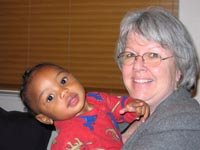
Not to be a typical grandma, but I had to post a photo in order to get a photo into my profile, so here it is. This little guy is 16 months old now, saying a few words, running around, hiding things in the garbage can, and generally being a ray of light to everyone around him. OK, I know, that's enough on that topic.

COABE 2006

I just got back from the COABE conference last night. Under the auspices of ALTN (Adult Learning and Technology Network), we did two pre-conference sessions, one on using PowerPoint in the classroom and one on digital video projects using MovieMaker. Both were very successful and participants were happy, but the turnout was disappointing. Maybe hands-on sessions like that aren't the right thing for COABE, or maybe we need to do more pre-conference publicity.

I attended Denise Guckert's very wide-rangeing session on Internet resources and got several great ideas. One that I will share here is the Web site www.quicktopic.com. On this site you can create a quick and dirty discussion board. Only one topic per board, but you can create as many as you want and it's extremely simple. I created one while I was in the workshop and emailed it to the California Technology Mentor list, and by the end of the workshop I had more than a dozen posts. You can see it here.